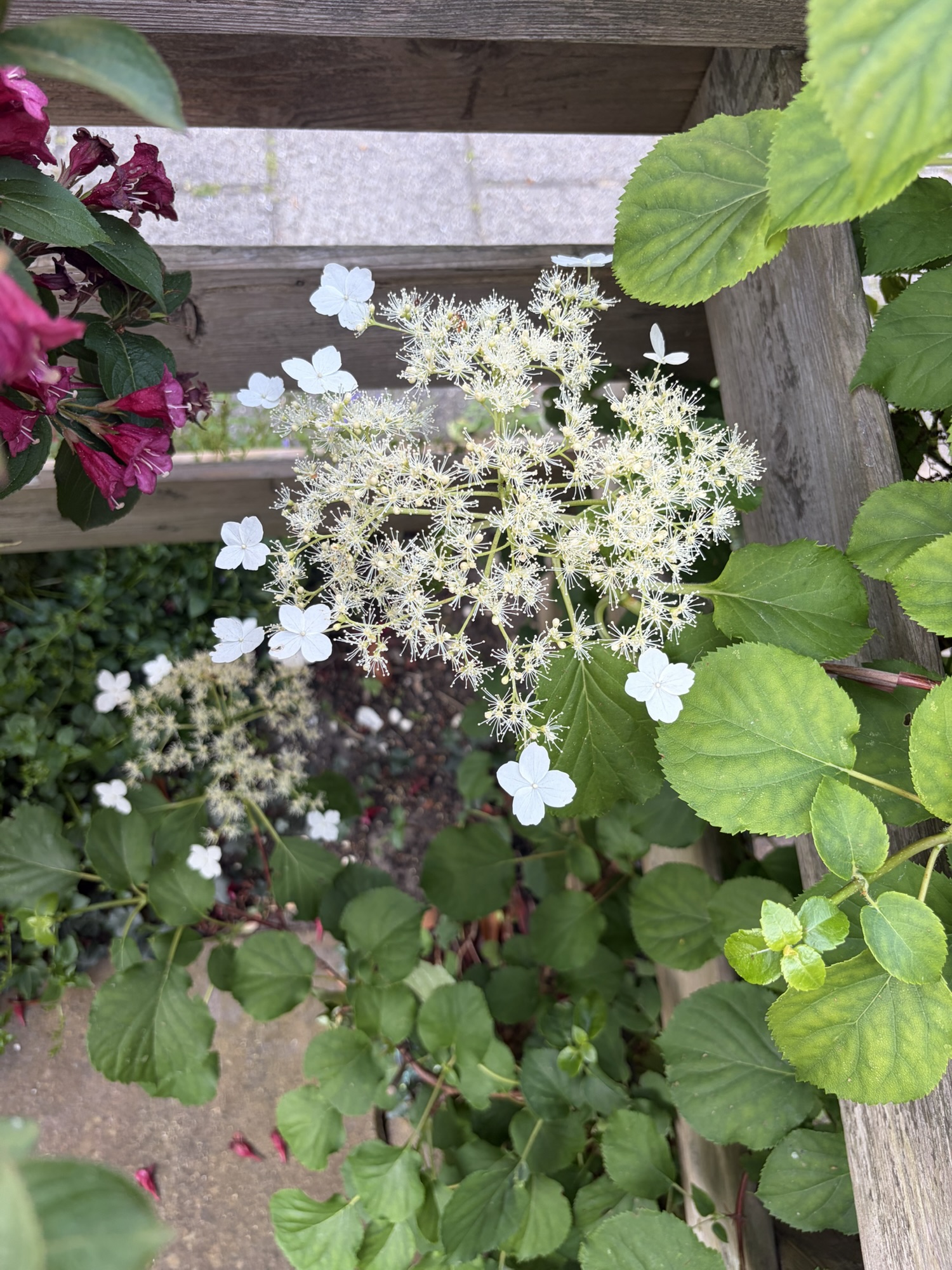
Hydrangeas are usually associated with generous borders and large, rounded shrubs. But there is another way to enjoy them in a small garden: grow them upwards.
Given time and care, a climbing hydrangea shrub would cover a wall or fence with lush foliage and delicate flowers without taking up much valuable ground space. Once established, climbing hydrangeas can become a beautiful piece of living architecture, softening a hard boundary while adding seasonal interest.

When we first moved into our house, the spot where the bakfiets (cargo bike) is currently standing ☝️ used to be home to 3 large hydrangeas. They were struggling, though. And I wanted the parking space 🅿️.
Fast-forward 7 years, and I now have two climbing hydrangeas: one in bloom by the fence, as you can see in the photo, and one, newly propagated, in a corner behind the bike (and not yet visible from this angle).
Note that climbing hydrangeas are slow to get started, and they need the right support and position.
Yet, give them some patience and care, and you will find that they are surprisingly well suited to a small garden.
Why Grow Climbing Hydrangeas in a Small Space?
It’s simple: a climbing hydrangea uses vertical space rather than valuable ground.
Training a climber against an unused wall or fence allows you to add considerably more greenery, figuratively pushing the border of your garden just a bit further out (and up).
Climbing hydrangeas also offer several other advantages:
- They are hardy and long-lived.
- They can tolerate some shade.
- They don’t need the constant tying-in that many twining climbers require.
- Their foliage creates a lush green backdrop.
- Mature plants produce large, attractive flower heads loved by many pollinators.
- They provide useful cover and shelter for garden wildlife.
Which Climbing Hydrangea Should You Grow?
The best-known species is Hydrangea anomala subsp. petiolaris, commonly called climbing hydrangea.
The subspecies petiolaris is the climbing hydrangea I have in my garden (and the ones you can see in the photos).
Another option is Hydrangea seemannii, an evergreen climbing hydrangea. It can be particularly interesting for a sheltered garden where year-round foliage is desirable, although it is less hardy than H. petiolaris and therefore needs a suitable position.
Planting Climbing Hydrangeas: Autumn or Spring?
If you’re planting a container-grown climbing hydrangea, you have some flexibility, such as moving it to a better spot or giving the container extra protection. Then either autumn or spring is a fine time to start.
On the other hand, if you are going to put the young climbing hydrangea shrub in the ground, you need to choose the season more carefully, considering your soil and your climate.

Why Autumn Can Be The Better Choice for Planting Climbing Hydrangeas
Autumn soil is often still warm from lingering summer heat, while cooler air reduces stress on newly planted hydrangeas.
With sufficient moisture, the roots can begin establishing before winter arrives.
If you pick autumn to plant your new climbing hydrangea, make sure you do it early enough to give the plant a chance to settle in before the weather turns harsh. I’ve made the mistake of planting too late with the first climbing hydrangeas I bought (and no longer have).
Why Spring Works Too
Spring planting gives you the whole growing season for the plant to settle in.
This can be particularly useful if your garden has heavy, wet winter soil or if you’re growing in a colder, exposed location.
Note that whichever season you choose, water the plant thoroughly after planting and keep an eye on it during its first summer.
Prepare the Soil Before Planting
Climbing hydrangeas are relatively adaptable, but they perform best in moist, fertile, well-drained soil.
Before planting, improve the soil with plenty of organic matter such as well-rotted compost.
The ideal soil should:
- retain moisture without becoming waterlogged
- contain plenty of organic matter
- allow roots to establish easily
If your soil is particularly dry or poor, improving it before planting is much easier than trying to correct the problem later.
What About Soil pH?
Unlike some other hydrangeas, climbing hydrangeas aren’t usually grown specifically for their flower colour, so you don’t need to manage soil acidity to achieve a particular bloom colour.
So, there’s no need to obsess over pH; just focus instead on good structure, moisture retention, and fertility.
Set Up Your Climbing Hydrangea Against a Wall or Fence
This is probably the most important part of growing one successfully in a small garden.
Climbing hydrangeas use aerial rootlets to attach themselves to suitable surfaces. On a rough masonry wall, an established plant may eventually support itself.
However, don’t assume it will immediately cling to everything. You might want to give your young plant a helping hand and some protection from the wind (or passers-by).
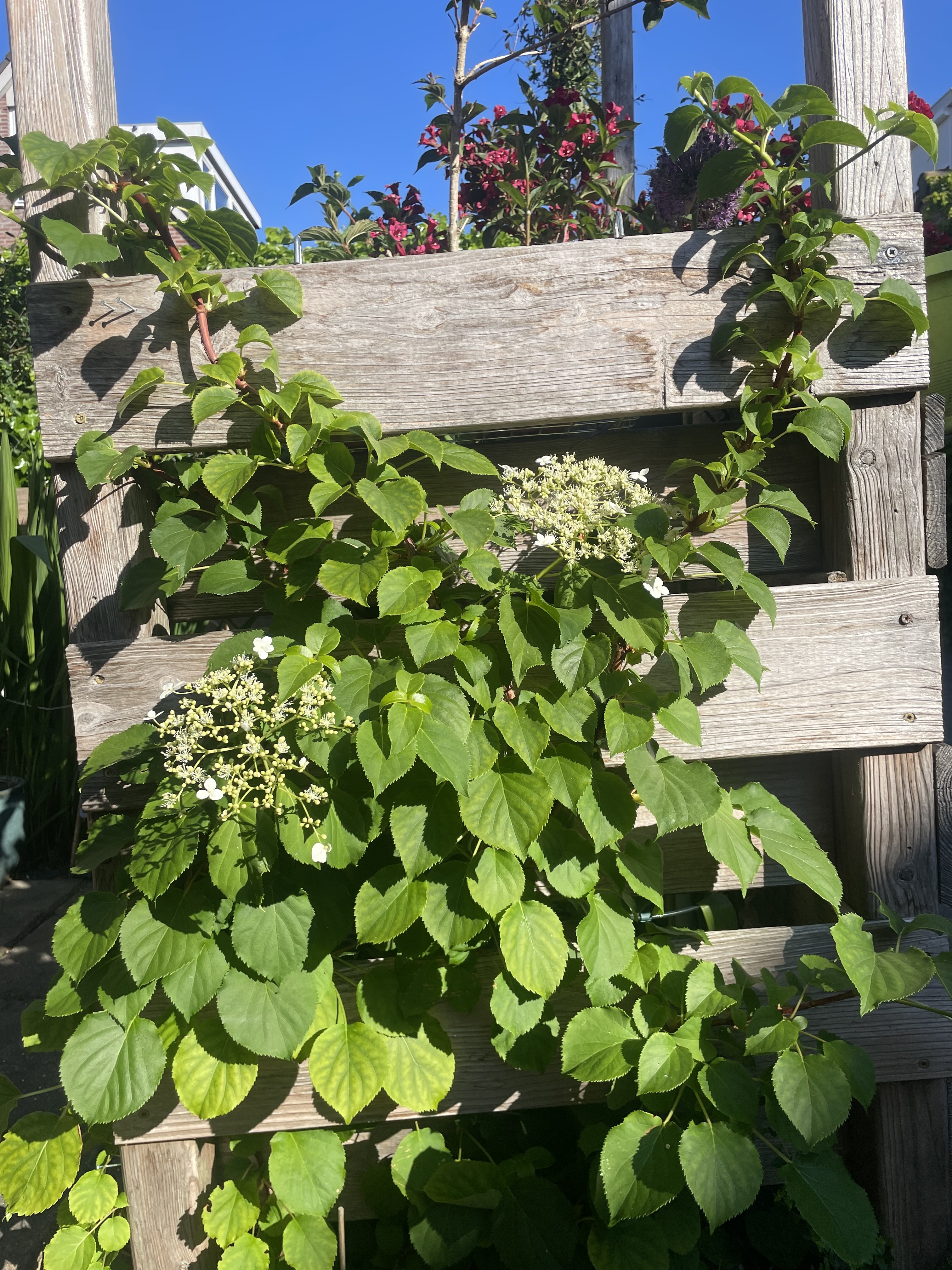
When young, guide the stems towards the wall or fence and tie them loosely to a suitable support.
For a fence, consider installing:
- horizontal wires
- trellis
- sturdy mesh,
- or simply nails and wires
This gives young stems somewhere to attach and helps you control the direction of growth.

Avoid tying stems tightly. Leave enough room for the stem to expand as it grows.
Think About the Wall Before Planting Climbing Hydrangeas
A wall can create a different growing environment from the rest of the garden.
A sunny south-facing wall may become hot and dry, while a north-facing wall can be much cooler and shadier.
Climbing hydrangeas tolerate partial shade and even quite shady conditions, meaning that they would grow quite happily (and large) against a north-facing wall. In a small garden, this makes them especially valuable for greening boundaries that might otherwise be tricky to plant.
Note that flowering is generally better when the plant receives some light.
Ongoing Care: Feed, Water, Prune and Support
Once established, climbing hydrangeas are relatively low-maintenance. But they tend to take a few years to settle, during which attention (and patience) is needed.
Watering
Keep newly planted plants consistently watered during dry periods.
This is particularly important if the plant is growing beside a wall, where the soil can become considerably drier than elsewhere.
Once established, climbing hydrangeas are much more resilient, but they still appreciate moisture during prolonged dry spells.
A thick organic mulch around the base can help retain moisture.
Keep the mulch away from direct contact with the main stem.
Feeding
Climbing hydrangeas generally don’t need excessive feeding.
A generous layer of compost or well-rotted organic matter around the plant in spring is often sufficient.
If growth is weak, a balanced general-purpose fertiliser can be applied in spring.
Avoid excessive nitrogen fertiliser. Encouraging lots of soft leafy growth isn’t necessarily helpful when your aim is a well-structured flowering climber.
Pruning
This is where growing a climbing hydrangea in a small garden differs from simply letting one cover a large wall.
You don’t necessarily need to prune every year.
Instead, prune when:
- the plant has outgrown its allotted space
- stems are growing where you don’t want them
- damaged or dead growth needs removing
- you need to maintain access to windows, gutters, paths, or structures
The safest approach is generally to prune after flowering, rather than cutting it back aggressively in winter.
Climbing hydrangeas flower on older wood, so heavy pruning at the wrong time can remove next year’s flowering potential.
Layering: Make a New Climbing Hydrangea for Free
Once your plant is established, you can potentially create new plants through layering.

How to Layer a Climbing Hydrangea
- Choose a healthy, flexible stem growing close to the ground.
- Gently bend part of the stem towards the soil.
- Make a shallow scrape on the underside of the stem if appropriate.
- Pin that section against the soil with a peg or piece of wire.
- Cover the pegged section with soil while leaving the growing tip exposed.
- Keep the area moist.
- Wait for roots to develop.
This isn’t a quick process, so patience is essential.
Once the layered section has developed a good root system, it can be separated from the parent plant and grown on independently.
The advantage of layering is that the new plant remains attached to the parent while roots are developing, making it a relatively forgiving propagation method.
A Slow Start Can Be Worth the Wait
There’s one thing I would tell anyone considering a climbing hydrangea for a small garden: patience.
Young plants can appear to do very little for the first couple of years.
It’s tempting to replace them with something faster-growing, especially when you want to see some green in an empty wall, quickly.
But once established, climbing hydrangeas can put on substantial growth and create the kind of mature, leafy wall that would be difficult to achieve with several smaller plants.
The trick is to give them the right support and enough time.
Final Thoughts
Growing hydrangeas vertically is a clever way to bring the beauty of these plants into a small garden without sacrificing precious ground space.
A climbing hydrangea can transform an otherwise bare wall or fence into a lush, flowering backdrop. Choose a suitable species, prepare the soil well, provide support while it’s young, and be patient during those first few years.
And once your plant is established, don’t forget that it can potentially provide you with new plants through layering.

